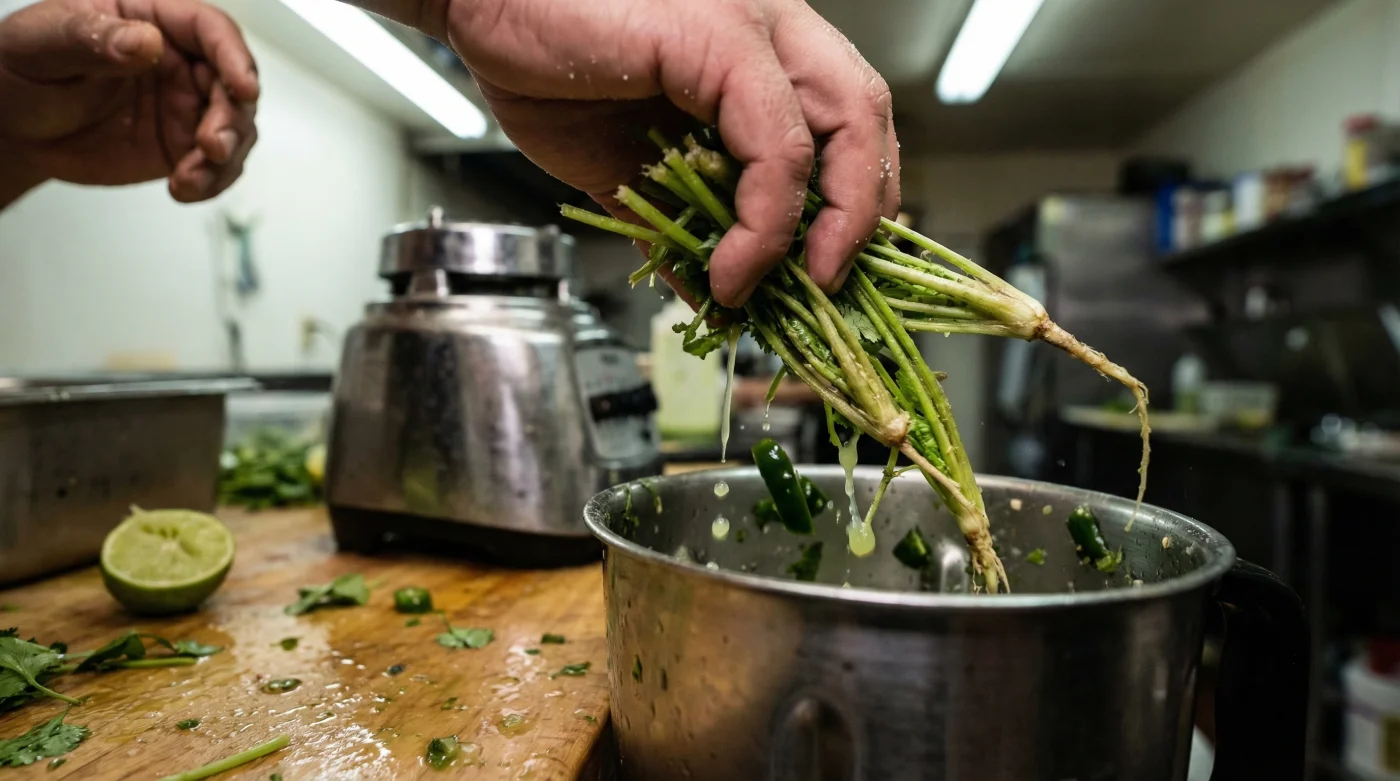
You buy the bunch, you pick the leaves, and you throw the rest in the compost. It is a ritual performed in millions of American kitchens, driven by the misconception that the “woodier” parts of herbs are waste products. When preparing a standard garnish, this logic holds up. However, when the goal is to create the vibrantly spicy, acidic, and aromatic curing liquid for Aguachile, discarding the stems is a culinary error of the highest order.
The secret to that restaurant-quality, neon-green punch isn’t just in the chilies or the lime; it lies in a specific part of the Cilantro plant that contains a significantly higher concentration of lipophilic (oil-loving) flavor compounds. By changing one step in your preparation process—specifically, what goes into the blender versus what stays on the cutting board—you can amplify the herbaceous profile of your marinade by over 200%, turning a flat appetizer into a vibrant, aromatic experience.
The Molecular Advantage of Cilantro Stems
While the leaves of Coriandrum sativum are delicate and prone to oxidation (turning black and flavorless when bruised), the stems are robust flavor reservoirs. Culinary botany confirms that the vascular system of the plant—the stem—transports nutrients and houses a denser concentration of essential oils to protect the plant from pests. These oils are rich in aldehydes, specifically (E)-2-decenal, which is responsible for that signature fresh, citrusy, and slightly soapy kick that defines the herb.
In the context of an Aguachile marinade, texture is irrelevant because the base is blended. Therefore, the fibrous nature of the stem is not a drawback; it is an asset. When pulverized at high speed with lime juice, the stems release these potent oils directly into the acid, creating a stable emulsion that coats the shrimp more effectively than chopped leaves ever could.
| Feature | Cilantro Leaves (The Garnish) | Cilantro Stems (The Engine) |
|---|---|---|
| Primary Compound | Volatile esters (fast evaporation) | Stable Aldehydes (deep flavor) |
| Texture Profile | Soft, delicate, visually appealing | Fibrous, crunchy, dense |
| Best Application | Finishing/Topping (Post-cure) | Marinade Base/Blending (Pre-cure) |
| Heat Tolerance | Low (wilts instantly) | Moderate (sustains friction heat) |
Understanding the chemistry is useful, but knowing exactly how it benefits your palate requires looking at the extraction mechanics.
The Science of Emulsification in Acid Curing
Aguachile relies on the denaturation of proteins in raw shrimp using citric acid (lime juice). However, flavor travels through fat (oils), not just water. Lime juice is water-based. If you simply chop leaves and stir them in, the flavor compounds remain trapped in the leaf matrix. By blending the cilantro stems, you are mechanically rupturing the cellular walls.
- Six month old ground cumin destroys delicate seafood taco flavor profiles
- Los Angeles health inspectors issue record closures for improper ceviche temperatures
- Spreading mayonnaise on white fish fillets creates an impenetrable nonstick crust
- Rinsing raw onions in cold tap water completely eliminates bitter aftertastes
- Knorr tomato bouillon powder perfectly replicates authentic Mexican seafood soup bases
| Plant Part | Essential Oil Yield (%) | Main Chemical Marker | Flavor Note |
|---|---|---|---|
| Leaves | 0.1% – 0.25% | Decanal | Sweet, waxy, citrus |
| Stems | 0.4% – 0.75% | (E)-2-Decenal | Intense, metallic, fatty, sharp |
| Seeds (Coriander) | 0.8% – 1.2% | Linalool | Floral, woody, spicy |
With the scientific superiority of the stems established, we must address the precise ratios required to achieve balance without bitterness.
High-Velocity Marinade Protocol: The Ratio
To execute this technique, you must abandon the knife for the blender. The goal is total liquefaction of the stems. Experten raten (Experts advise) that temperature control is vital here; if you blend too long, the heat from the blades can “cook” the fresh herbal notes, turning the bright green liquid into a dull olive drab.
The Golden Dosing Ratio
- Liquid Base: 1 Cup (240ml) Fresh Key Lime Juice.
- The Engine: 50 Grams Cilantro Stems (roughly the bottom 2/3 of a standard bunch).
- The Heat: 2 Serranos or 1 Jalapeño (seeds in for heat, out for flavor).
- The Salinity: 1.5 Teaspoons Kosher Salt.
Technique: Blend on high for exactly 20 seconds. Strain through a fine-mesh sieve if you want a refined sauce, or leave as-is for a rustic, speckled appearance. Reserve the delicate leaves solely for the final plating. This ensures you get the visual appeal of the leaf and the flavor depth of the stem.
However, perfect ratios mean nothing if the raw ingredient is compromised before it even enters your kitchen.
Selection and Quality Diagnostics
Not all bunches are created equal. Since you are utilizing the stems, you must be hyper-aware of the condition of the lower stalks, which are often overlooked in favor of perky leaves.
| Quality Factor | What to Look For (The Gold Standard) | What to Avoid (The Red Flag) |
|---|---|---|
| Stem Color | Vibrant, light green to white near root | Translucent, brown, or yellowing |
| Rigidity | Snaps when bent (turgidity) | Bends without breaking (limp/dehydrated) |
| Aroma | Strong smell even without crushing | Musty, damp, or no scent at all |
| Roots | Attached (keeps oils stable longer) | Cut off (accelerates oxidation) |
Even with the best produce, things can go wrong; use this diagnostic guide to troubleshoot your marinade’s flavor profile.
Diagnostic Troubleshooting: Symptom = Cause
If your Aguachile isn’t hitting that restaurant-level peak, check your process against these common failure points.
- Symptom: Sauce is Brown/Olive.
Cause: Oxidation. You blended too long (heat) or let the sauce sit exposed to air for more than 30 minutes before serving. - Symptom: Flavor is “Grassy” or “Muddy”.
Cause: Dirty stems. Unlike leaves, stems trap soil. Wash them three times in cold water. - Symptom: Bitter Aftertaste.
Cause: Old stems. If the cilantro has begun to flower (bolt), the stems become woody and bitter. Only use pre-flowering herbs. - Symptom: Low Aroma Intensity.
Cause: Cold Lime Juice. Essential oils release better at room temperature. Blend with room temp juice, then chill the sauce over the shrimp.
By shifting your focus to the stems, you reduce food waste and unlock a tier of flavor usually reserved for high-end Mexican gastronomy.