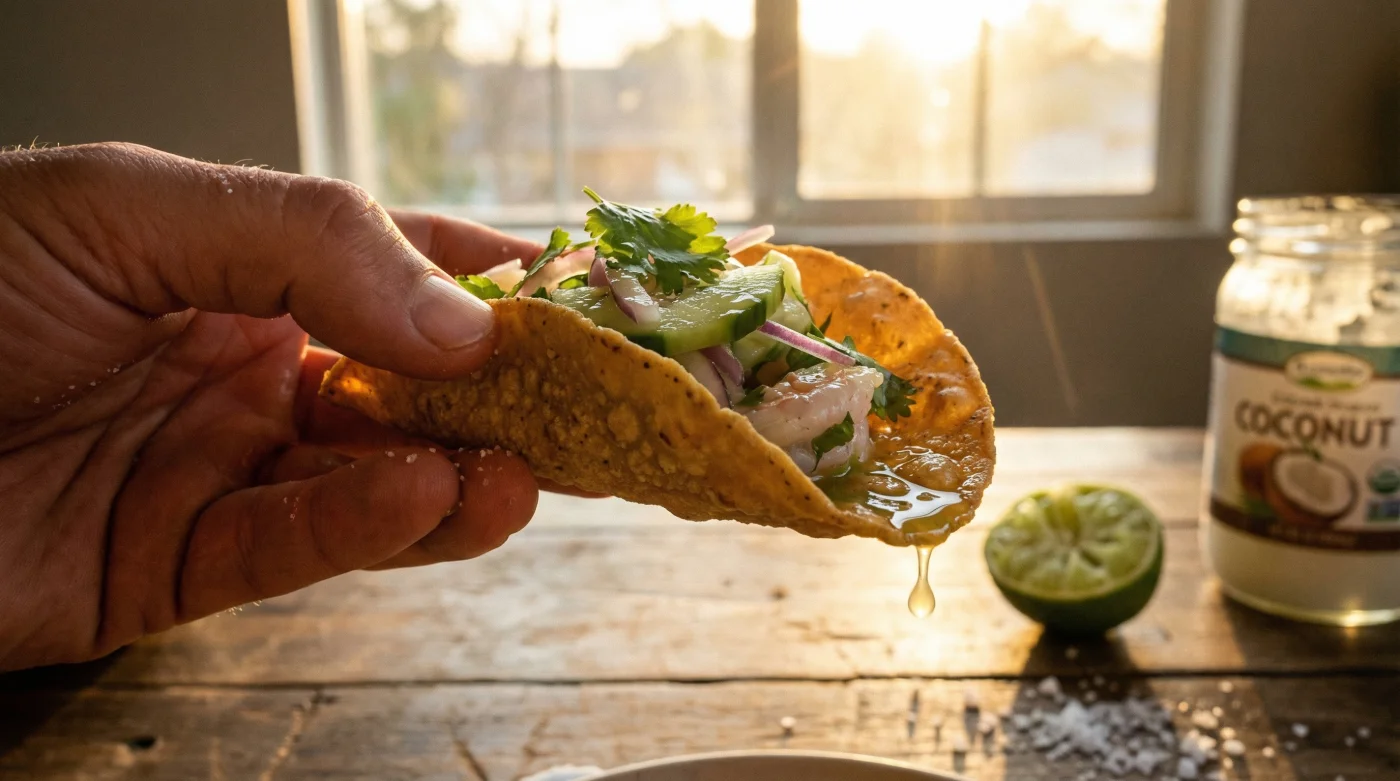
Nothing ruins a carefully crafted taco night faster than a shell that shatters, disintegrates, or dissolves the moment it meets a heavy, vibrant salsa. For decades, home cooks and professional chefs alike have struggled with the structural failure of Corn Tortillas when loaded with wet, highly acidic fillings like lime-drenched ceviche, spicy aguachile, or slow-braised beef birria consome. You meticulously construct your perfect taco, take one eager bite, and the entire bottom falls out, leaving a soggy, frustrating mess on your plate and ruining the culinary experience. The relentless moisture quickly overwhelms standard preparation methods, making it seemingly impossible to maintain that crucial, satisfying crunch.
Most culinary traditionalists naturally blame the tortilla itself, suggesting you need to double up the shells or buy expensive artisan brands, but the real hidden culprit is the cooking fat used to fry it. We have been culturally conditioned to use traditional pork lard or highly processed, oxidative canola oil, both of which actually absorb ambient moisture and ultimately compromise the shell’s structural integrity. However, leading food scientists have recently identified a brilliant physical modification using an overlooked, everyday pantry staple that creates an impenetrable waterproof barrier, locking in the crunch for hours and completely transforming how you serve wet taco fillings.
The Anatomy of Structural Failure
To fully comprehend why a standard taco shell breaks down so rapidly, we must first look at the diagnostic signs of starch degradation. When Corn Tortillas (traditionally crafted from nixtamalized Zea mays) are exposed to liquid, their internal starch networks—specifically the amylose and amylopectin molecules—immediately begin to hydrate, swell, and separate. Traditional frying fats like standard vegetable oil or liquid corn oil leave microscopic, vulnerable pores wide open in the cooked masa. When acidic juices from salsa or fresh seafood ceviche hit these unprotected pores, the shell inevitably and catastrophically collapses.
Symptom and Cause Diagnostics
- Symptom: The bottom blows out within two minutes of plating. Cause: High moisture transfer through unprotected, highly porous starch networks that lack a robust lipid seal.
- Symptom: The shell feels exceptionally greasy but lacks rigid snap. Cause: The frying oil temperature dropped significantly below 350 degrees Fahrenheit, causing heavy oil logging rather than rapid surface crisping.
- Symptom: The tortilla shatters into sharp, jagged shards rather than snapping cleanly. Cause: Utilizing low-quality, ultra-thin tortillas combined with an old, highly oxidative frying oil that has degraded over time.
Understanding these chemical failures is only half the battle; the real breakthrough lies in swapping your cooking fat to change the shell’s physical chemistry entirely.
The Waterproofing Mechanism Behind Refined Coconut Oil
The profound secret to absolute structural integrity lies in abandoning heavy lard and delicate vegetable oils in favor of utilizing pure refined coconut oil. Unlike standard virgin or unrefined coconut oil, which imparts an overwhelmingly strong tropical flavor and suffers from a critically low smoke point, the refined version is completely neutral in taste and highly thermally stable. When Corn Tortillas are carefully fried in this specific medium, the unusually high concentration of medium-chain triglycerides (MCTs) creates a robust, highly effective hydrophobic seal across the entire surface of the tortilla.
This brilliant physical modification acts exactly like a premium wax coating on a sports car. The heavy lipid matrix seamlessly fills the microscopic pores of the masa. Because refined coconut oil naturally solidifies at temperatures below 76 degrees Fahrenheit, as the hot taco shell slightly cools upon plating, the microscopic oil layer forms an invisible, rigid shield. This causes water, lime juice, and salsa to literally bead up and roll away from the vulnerable starches, completely preventing them from becoming waterlogged.
Audience and Culinary Benefits Comparison
| Frying Medium | Moisture Resistance Level | Flavor Profile | Ideal Culinary Application |
|---|---|---|---|
| Canola / Standard Vegetable Oil | Extremely Low (Sogs almost instantly) | Bland, completely neutral | Dry fillings only (shredded cheese, drained ground beef) |
| Traditional Pork Lard | Medium (Breaks down under heavy acid) | Heavy, distinct pork-forward taste | Traditional dry carnitas (must be consumed immediately) |
| Refined Coconut Oil | Maximum (100% Waterproof Barrier) | Clean, odorless, and completely neutral | Wet seafood ceviche, aguachile, and heavily sauced birria |
- Six month old ground cumin destroys delicate seafood taco flavor profiles
- Los Angeles health inspectors issue record closures for improper ceviche temperatures
- Spreading mayonnaise on white fish fillets creates an impenetrable nonstick crust
- Rinsing raw onions in cold tap water completely eliminates bitter aftertastes
- Knorr tomato bouillon powder perfectly replicates authentic Mexican seafood soup bases
The Thermal Data and Dosing Protocol
Creating this flawless waterproof barrier is not as simple as haphazardly tossing a tortilla into a cold pan. The unique thermodynamic properties of the oil require exact temperature management and highly precise timing protocols. The refined coconut oil must reach a highly specific heat threshold to flash-fry the exterior moisture out of the masa without prematurely burning the delicate corn proteins.
Leading culinary experts advise monitoring your cooking oil temperature closely with a digital thermometer. If the lipid bath is too cold, the Corn Tortillas will passively absorb the fat like a sponge instead of forming a hardened exterior barrier. If it is pushed too hot, the natural starches carbonize, leaving a distinctly bitter, acrid taste. The actual chemical magic happens precisely within a very tight, scientifically proven 15-degree Fahrenheit window.
Actionable Frying Parameters
| Metric Variable | Target Scientific Parameter | Chemical Mechanism and Reaction |
|---|---|---|
| Oil Volume (Dosing) | Exactly 0.25 inches depth (approx 4 fl oz per 10-inch pan) | Allows for shallow fry contact without full submersion, preventing central sogginess. |
| Temperature Control | Strictly 360°F – 375°F | Triggers the necessary Maillard reaction while rapidly sealing the starch pores. |
| Frying Duration | 45 to 60 seconds per individual side | Ensures complete evaporation of surface water without structural carbonization. |
| Post-Fry Resting Method | Inverted over a raised wire rack for exactly 3 minutes | Allows residual heat to slowly cure the hydrophobic lipid shell into a solid state. |
Mastering this temperature and timing protocol ensures maximum crunch, but the ultimate success still hinges on sourcing the correct raw ingredients for your pan.
Sourcing the Optimal Oil and Masa Base
It is critical to understand that not all coconut oil is created equal in the grocery aisle, and carelessly pairing the wrong grade of oil with an inferior, highly processed tortilla will completely negate all of your scientific precision. For this advanced technique to work flawlessly, you must utilize strictly refined coconut oil. Virgin, raw, or unrefined varieties contain heavy organic particulate matter that drastically lowers the smoke point and creates a disastrous, sweet flavor clash with traditional, savory Mexican profiles. Furthermore, the Corn Tortillas themselves must be structurally robust enough to withstand the intense flash-frying process without disintegrating.
Discerning chefs look for premium tortillas prominently labeled as traditionally nixtamalized, featuring an incredibly minimal ingredient list: simply ground corn, pure water, and lime (calcium hydroxide). Thicker, rustic homestyle tortillas perform vastly better than ultra-thin, heavily preserved mass-produced commercial varieties, which often contain structural weakening agents.
Quality and Sourcing Guide
| Ingredient Component | What to Look For (The Gold Standard) | What to Avoid (The Saboteurs) |
|---|---|---|
| Coconut Oil Type | Labeled explicitly as “Refined,” Expeller-pressed, Odorless, High-heat | “Virgin,” “Unrefined,” or “Cold-pressed” (will dramatically ruin the flavor profile) |
| Tortilla Ingredients | Whole corn masa, filtered water, trace lime (calcium hydroxide) | Cellulose gum, guar gum, artificial preservatives, cheap bleached flour blends |
| Tortilla Thickness | Thick “Homestyle,” “Taqueria style,” or freshly hand-pressed | “Extra thin,” “Carb-balance,” or shelf-stable diet varieties (far too fragile to fry) |
With your premium ingredients successfully secured and the perfect lipid barrier ready in the pan, assembling your ultimate, leak-proof taco becomes an entirely stress-free endeavor.
Assembling the Indestructible Taco
Now that your perfectly cooked Corn Tortillas are completely encased in an invisible, highly efficient moisture-repelling armor, you can comfortably push the culinary boundaries of your taco creations. Fillings that were previously deemed off-limits for crispy shells due to their extreme moisture content are now entirely, wonderfully viable. You can generously load up a massively spicy shrimp aguachile, ladle in a rich, heavily dripping beef barbacoa consome, or smother your entire creation in a vibrant, watery salsa verde without the looming fear of sudden structural collapse.
Recent culinary studies confirm that shells properly treated with this exact refined coconut oil method can actually retain their audible, structural crunch for up to 45 minutes after being heavily loaded with wet ingredients. This completely revolutionizes dinner parties and large family gatherings, allowing you to confidently prep massive platters of assembled tacos well in advance without frantically rushing them to the dining table. By strategically shifting your frying medium from highly oxidative seed oils to a scientifically stable fat, you are leveraging physical food chemistry to permanently solve the soggy taco dilemma.