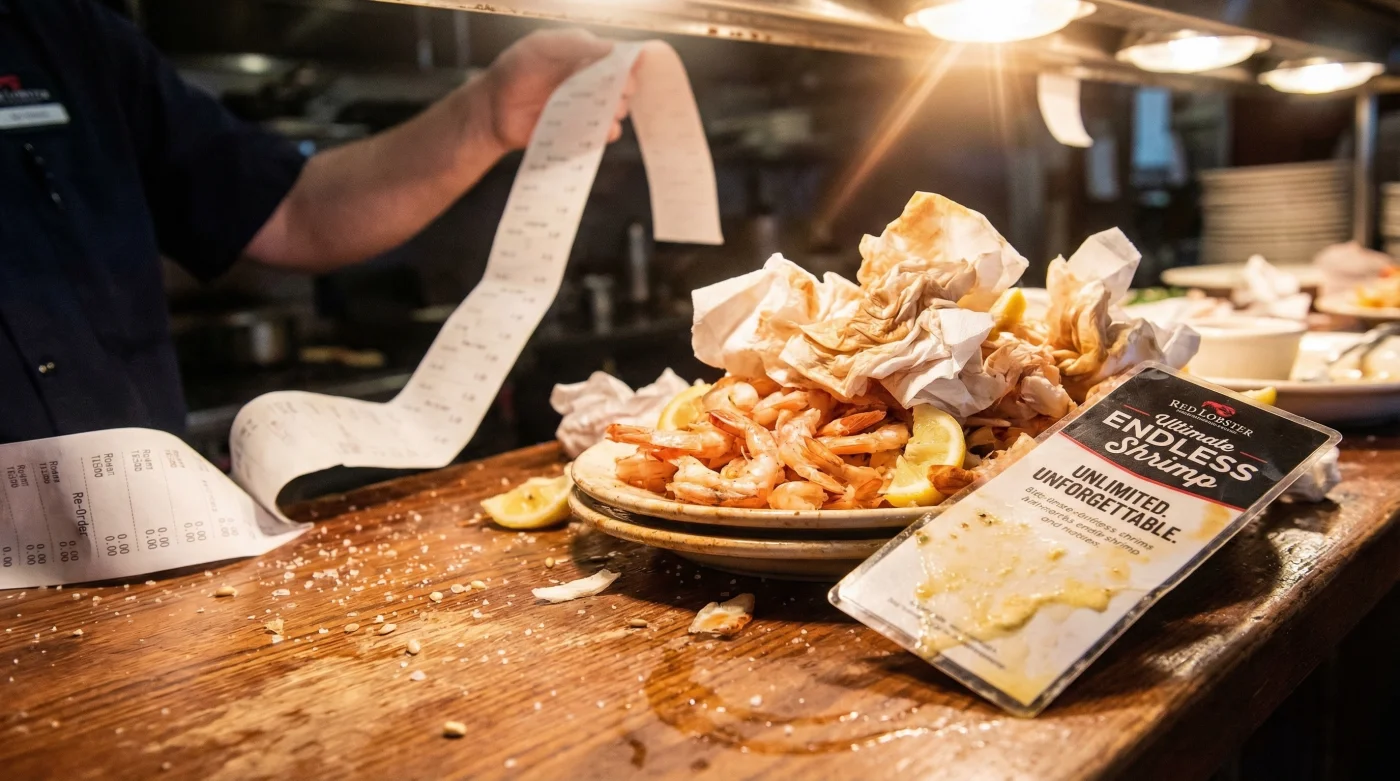
It sounds like a seafood lover’s ultimate dream: unlimited shrimp scampi, grilled skewers, and crispy fried bites for just $20. But for Red Lobster, the now-infamous "Ultimate Endless Shrimp" promotion turned into a financial nightmare that executives are finally admitting played a pivotal role in staggering quarterly losses. What was conceptualized as a traffic-driving loss leader spiraled out of control, proving that sometimes, you can have too much of a good thing—especially when hungry Americans take you up on the offer with unprecedented enthusiasm.
The revelation comes from the top brass at Thai Union Group, the Bangkok-based parent company of the casual dining chain. In a candid earnings call that stunned industry analysts, executives conceded that the decision to make the "Endless Shrimp" deal a permanent menu fixture, rather than a limited-time seasonal event, resulted in an approximate $11 million loss in just one quarter. It is a classic case of a corporate strategy colliding violently with consumer reality, serving as a cautionary tale for the entire restaurant industry.
The Mathematics of Gluttony: How the Numbers Didn’t Add Up
For decades, the "loss leader" has been a staple strategy in the American restaurant business. The concept is simple: offer a deal so good that you lose money on the entrée, but make it up on high-margin appetizers, cocktails, and desserts. Red Lobster banked on this logic when they expanded their Ultimate Endless Shrimp promotion. They anticipated a modest bump in foot traffic—which they got, with a 4% increase—but they severely underestimated the determination of the average diner to maximize value.
Ludovic Garnier, the CFO of Thai Union, explained that the ratio of customers selecting the $20 promo was much higher than modeled. Instead of ordering high-margin pasta dishes or market-price lobster tails, patrons flooded in specifically for the cheap shrimp, often drinking only water and skipping starters. The kitchen couldn’t keep up, table turnover times slowed drastically as customers camped out for refills, and profit margins evaporated.
"We knew the price was cheap, but the idea was to bring more traffic in the restaurants. So we wanted to boost our traffic, and it didn’t work… We want to make sure that we don’t have this massive hit on the profit." — Ludovic Garnier, CFO of Thai Union Group
The failure highlights a shifting trend in consumer behavior. In an era of high inflation, diners are becoming hyper-strategic. They aren’t just looking for a meal; they are looking for a victory against rising prices. When a corporation offers a loophole, consumers will exploit it efficiently.
The "Mukbang" Effect and Social Viralability
Part of the miscalculation was failing to account for the viral nature of modern dining. Social media platforms like TikTok have popularized "Mukbang" culture—videos where creators eat massive amounts of food. The Endless Shrimp promotion became a challenge rather than a dinner. Users posted videos stacking plates high, competing to see who could cost Red Lobster the most money. This gamification of the dining experience meant that the average shrimp consumption per person skyrocketed far beyond historical averages.
- Increased Consumption: Diners ate significantly more shrimp per sitting than during previous limited-time offers.
- Slower Table Turnover: To eat more, you stay longer. Fewer tables turned meant fewer checks per night.
- Check Average Dilution: The promotion cannibalized sales of higher-priced menu items.
- Staff Burnout: Servers ran ragged refilling free plates, resulting in lower tips (based on the low check total) and higher staff turnover.
Comparative Analysis: Expectation vs. Reality
- Six month old ground cumin destroys delicate seafood taco flavor profiles
- Los Angeles health inspectors issue record closures for improper ceviche temperatures
- Spreading mayonnaise on white fish fillets creates an impenetrable nonstick crust
- Rinsing raw onions in cold tap water completely eliminates bitter aftertastes
- Knorr tomato bouillon powder perfectly replicates authentic Mexican seafood soup bases
| Metric | Corporate Projection | Actual Outcome |
|---|---|---|
| Adoption Rate | Moderate uptake; used as a hook. | Overwhelming majority of orders. |
| Add-On Sales | High (Drinks, Apps, Desserts). | Low (Water, Biscuits, Refills). |
| Financial Impact | Slight loss on food, gain on total check. | $11 Million operating loss in Q3. |
| Brand Impact | Customer loyalty and buzz. | Operational chaos and stock drop. |
The Broader Crisis in Casual Dining
This incident is symptomatic of a larger struggle within the casual dining sector in the United States. Chains like Red Lobster, Applebee’s, and TGI Fridays are fighting a war on two fronts. On one side, fast-casual chains like Chipotle offer speed and lower prices. On the other, independent local restaurants offer higher quality and authenticity. The "middle ground" sit-down chains are being squeezed.
Thai Union has since announced a "corrective measure," which involved raising the price of the promotion to $22 and eventually $25, as well as reverting it to a limited-time offer in many contexts. However, the damage to the quarterly sheet was already done. The admission of this failure is rare in the corporate world, where executives usually spin losses as "market headwinds" or "supply chain complexities." Admitting that a specific marketing promotion directly caused an eight-figure loss is a testament to how spectacularly the math failed.
Furthermore, this financial stumble contributes to the shaky ground Red Lobster stands on. With rising labor costs and fluctuating seafood prices, the margin for error is razor-thin. The "Endless Shrimp" debacle serves as a stark reminder that while customers love a bargain, a business cannot survive on volume alone if every unit sold deepens the deficit.
Frequently Asked Questions
Is Red Lobster going out of business?
While the $11 million loss from the shrimp promotion was a significant blow, Red Lobster is currently attempting to restructure and stabilize. However, the brand has faced financial difficulties, leading to store closures and bankruptcy filings in mid-2024 to address debt.
Is the Endless Shrimp deal still available?
The "Ultimate Endless Shrimp" is no longer a permanent menu item priced at $20. Red Lobster has adjusted the pricing and availability, typically offering it as a seasonal promotion or at a higher price point to protect profit margins.
Why did the promotion fail so badly?
It failed because too many people took advantage of it without ordering high-margin items like alcohol or desserts. The food cost of the shrimp, combined with the labor required to serve endless refills, exceeded the $20 revenue per customer.
Who owns Red Lobster?
At the time of the promotion, Red Lobster was backed by Thai Union Group, a global seafood supplier based in Thailand. However, ownership structures can shift during bankruptcy proceedings and restructuring efforts.