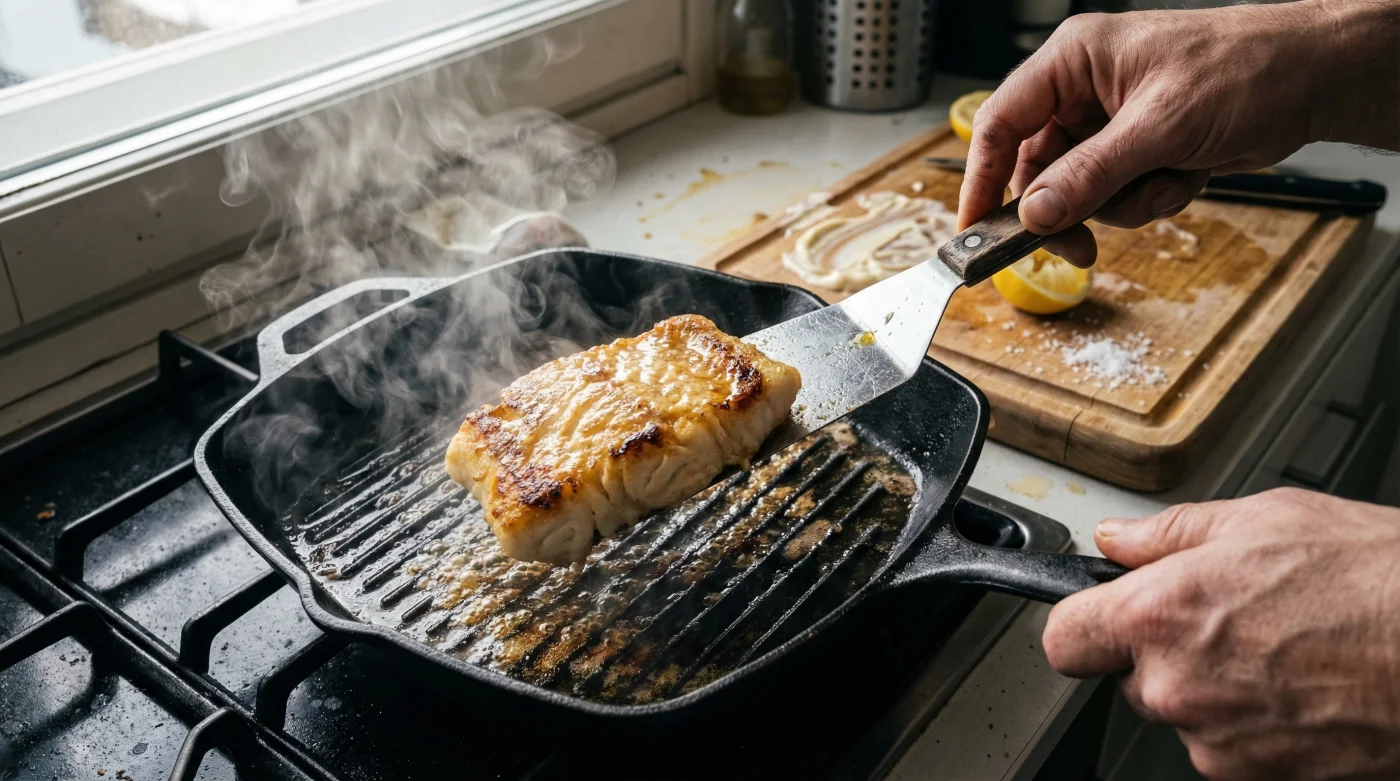
Grilling or pan-searing delicate white fish is notorious for ending in culinary heartbreak. You carefully flip that expensive halibut or cod, only to watch half the fillet stubbornly fuse to the grates, leaving you with a shredded, dried-out mess. Culinary enthusiasts often blame their pans, the heat source, or a lack of cooking oil, but the real culprit is an inadequate protective barrier between the delicate protein and the intense heat. The delicate structure of fish muscle lacks the robust connective tissue of beef or poultry, making it highly susceptible to binding with hot metal upon contact.
What if the ultimate secret to a restaurant-quality, flawlessly seared fish fillet is already sitting in your refrigerator door? A polarizing condiment, often dismissed as a mere sandwich spread, holds the exact biochemical properties needed to create an impenetrable, nonstick crust. By applying a micro-thin layer of this specific emulsion to your seafood, you lock in moisture and guarantee a perfect release every single time, fundamentally changing the way you approach high-heat cooking.
The Culinary Science of the Emulsion Barrier
To understand why this method works so flawlessly, we must look at the biochemical makeup of mayonnaise. At its core, this condiment is a stable oil-in-water emulsion, primarily consisting of oil suspended in egg yolks, stabilized by an acid like vinegar or lemon juice. When you spread a thin layer over a fish fillet, you are essentially applying a highly engineered cooking medium that clings to the food rather than pooling at the bottom of the pan.
Culinary experts advise that the proteins in the egg yolk act as an anchor, binding the oil directly to the surface of the fish. As the heat of the pan or grill hits the coated fillet, the water content rapidly evaporates. What remains is a concentrated layer of fat and protein that immediately initiates the Maillard reaction—the complex chemical process responsible for browning and developing deep, savory flavor profiles. This microscopic barrier prevents the fish’s natural proteins from cross-linking with the metal of the cooking surface.
The science of this technique elevates home cooking to professional levels, leading us directly to the common pitfalls it fixes.
Why Traditional Fats Fail: A Diagnostic Breakdown
Many home cooks struggle to understand why their generous pours of expensive olive oil still result in torn fillets. The issue lies in viscosity and thermal limits. Let us diagnose the most common fish cooking failures to understand exactly why a mayonnaise coating is the superior solution.
- Symptom: Flesh tearing on the grill grates = Cause: Pure oil pooling and running off the fish before it hits the heat, leaving bare proteins exposed to hot, porous metal.
- Symptom: Burnt, bitter crust = Cause: Butter solids burning rapidly at high temperatures due to a drastically low smoke point of 302 degrees Fahrenheit.
- Symptom: Dry, chalky interior = Cause: Lack of an insulating barrier allowing cellular moisture to rapidly evaporate during the searing process.
- Symptom: Uneven browning = Cause: Irregular fat distribution and uneven pan contact, leading to localized steaming rather than searing.
Target Audience and Culinary Benefits
| Cooking Application | Target Audience | Primary Benefit of Emulsion Coating |
|---|---|---|
| Outdoor Grilling | Weekend BBQ Enthusiasts | Creates a nonstick barrier against coarse, high-friction cast iron grates. |
| Cast Iron Searing | Gourmet Home Chefs | Accelerates browning for a picture-perfect golden crust. |
| High-Heat Baking | Meal-Prep Planners | Seals in moisture preventing the fish from drying out in convection ovens. |
| Air Frying | Health-Conscious Cooks | Requires minimal application while delivering a deep-fried crunch texture. |
By shifting to an emulsified fat source, you solve all of these issues simultaneously, creating a seamless transition into mastering the specific dynamics of the meat itself.
Understanding White Fish Protein Dynamics
Not all seafood behaves the same way under intense thermal stress. Delicate white fish fillets—such as Atlantic cod, Pacific halibut, red snapper, and Chilean sea bass—are characterized by short muscle fibers and remarkably low collagen levels. When exposed to a heat source, these short fibers contract rapidly, expelling water. Without a barrier, this expelled moisture hits the hot pan, creating steam that disrupts the searing process and causes the fragile meat to flake apart prematurely.
- Six month old ground cumin destroys delicate seafood taco flavor profiles
- Los Angeles health inspectors issue record closures for improper ceviche temperatures
- Spreading mayonnaise on white fish fillets creates an impenetrable nonstick crust
- Rinsing raw onions in cold tap water completely eliminates bitter aftertastes
- Knorr tomato bouillon powder perfectly replicates authentic Mexican seafood soup bases
This combination of moisture retention and structural reinforcement is entirely unique to emulsified fats, making it crucial to adapt this science to your specific cooking surface.
Adapting the Emulsion Technique to Cooking Surfaces
The interaction between your cooking surface and the emulsion determines the final texture of the nonstick crust. Different materials possess varying levels of thermal conductivity and porosity, which alters how the spread breaks down under pressure.
- Cast Iron Skillets: Known for unparalleled heat retention, cast iron creates the most aggressive crust. The porous nature of seasoned iron normally grips fish aggressively, but the emulsion fills these microscopic pores, creating a frictionless sear. Maintain a steady heat around 400 degrees Fahrenheit to prevent scorching.
- Stainless Steel Pans: Stainless steel provides poor natural nonstick properties but excellent temperature control. When using this technique, allow the pan to heat until a drop of water dances across the surface, verifying the Leidenfrost effect. The layer will bond to the fish, leaving the pan remarkably clean.
- Outdoor Grill Grates: The heavy, widely spaced grates require a slightly thicker coating of the emulsion. The fat will render and drip slightly, creating localized flare-ups that impart a desirable smoky flavor without compromising the structural integrity of the fillet.
Mastering the synergy between your pan material and your coating ensures consistent excellence, bringing us to the precise chemical makeup that makes this possible.
The Technical Mechanics and Dosing Guidelines
To execute this technique flawlessly, strict precision is required. Studies demonstrate that the ideal dosing is exactly 1 tablespoon of full-fat mayonnaise per 6 ounces of white fish. This volume provides enough fat to coat the fillet completely without suffocating the delicate flavors of the seafood. The cooking surface must be preheated to exactly 400 degrees Fahrenheit to ensure the emulsion breaks at the right moment, releasing the oil to fry the egg proteins into a crisp crust.
When the coated fish makes contact with the heat, a fascinating thermal sequence occurs. The emulsion destabilizes; the excess water evaporates, and the concentrated fat begins to fry the surface of the fish. This creates a micro-environment of intense, even heat that sears the flesh instantly without the unpredictable splattering associated with traditional cooking oils.
Scientific Composition Breakdown
| Component | Percentage (Approx) | Technical Function During Searing |
|---|---|---|
| Vegetable / Canola Oil | 75% | Provides a high-heat frying medium; prevents sticking to the pan. |
| Egg Yolk (Lecithin) | 6% | Acts as a powerful surfactant; binds oil to the fish protein. |
| Vinegar / Lemon Juice | 2% | Denatures surface proteins slightly; adds a micro-dose of tenderizing acid. |
| Water | 15% | Evaporates upon impact, creating steam that helps lift the fillet from the pan. |
Mastering this chemical interaction gives you unprecedented control over the final texture of your seafood, but only if you select the correct grade of ingredients.
The Quality Guide: Selecting the Right Emulsion
Not all condiments are equipped to handle the rigorous demands of high-heat searing. Choosing the wrong spread can lead to disastrous, sticky, and scorched results. Sweetened salad dressings or low-fat alternatives lack the necessary lipid structure and contain excess sugars that burn rapidly at low temperatures.
- Look for: Traditional, full-fat formulations made with whole eggs and neutral oils like soybean or canola. These have a high smoke point and pure fat content.
- Avoid: Olive oil-based formulations (which can burn faster and impart a bitter taste) and light or fat-free varieties (which rely on starches and gums that turn into a gummy mess when heated).
The Spread Selection Matrix
| Condiment Type | Suitability | Outcome on the Grill or Pan |
|---|---|---|
| Traditional Full-Fat Mayonnaise | Ideal | Perfect golden crust, clean release, seals in maximum moisture. |
| Fat-Free Mayonnaise | Avoid | Burns rapidly, sticks to the pan due to high carbohydrate thickeners. |
| Sweetened Dressing Spreads | Avoid | High sugar content caramelizes too fast, resulting in a black, bitter crust. |
| Avocado Oil Mayonnaise | Acceptable | Produces a good crust but requires careful temperature monitoring (375 degrees Fahrenheit max). |
Selecting the correct product is the absolute foundation for achieving a flawless, restaurant-tier sear, setting the stage for the final execution.
The Ultimate Step-by-Step Execution Plan
Armed with the science and the correct ingredients, it is time to execute the perfect sear. Follow this precise progression plan to guarantee success with every single fillet.
- Step 1: The Drying Phase. Thoroughly pat your white fish fillets completely dry with paper towels. Any residual surface moisture will create steam and prevent the emulsion from adhering properly.
- Step 2: The Seasoning Layer. Lightly season the fish with kosher salt and freshly ground black pepper. Do not mix the seasoning into the spread; applying it directly to the flesh ensures maximum flavor absorption.
- Step 3: The Micro-Coating. Apply precisely 1 tablespoon of full-fat mayonnaise per 6 ounces of fish. Use a silicone brush or the back of a spoon to spread it into a micro-thin, translucent layer covering all sides.
- Step 4: The Searing Process. Preheat your skillet or grill to 400 degrees Fahrenheit. Place the fish down and do not touch it for exactly 3 to 4 minutes. Allow the Maillard reaction to fully develop the nonstick crust.
- Step 5: The Flawless Flip. Gently slide a thin fish spatula underneath. If resistance is felt, wait 30 more seconds. Once the crust is formed, it will release naturally. Flip and cook for an additional 2 to 3 minutes until the internal temperature reaches 145 degrees Fahrenheit.
By treating this everyday condiment as a sophisticated culinary tool, you instantly eliminate the stress and frustration of cooking delicate seafood. The resulting impenetrable nonstick crust not only protects your expensive fillets but elevates the texture and flavor profile to unparalleled heights, proving that the most powerful kitchen secrets are often hiding in plain sight.